CSPM vs CNAPP vs CWPP: Understanding Cloud Security Platforms
 Sajid Saiyed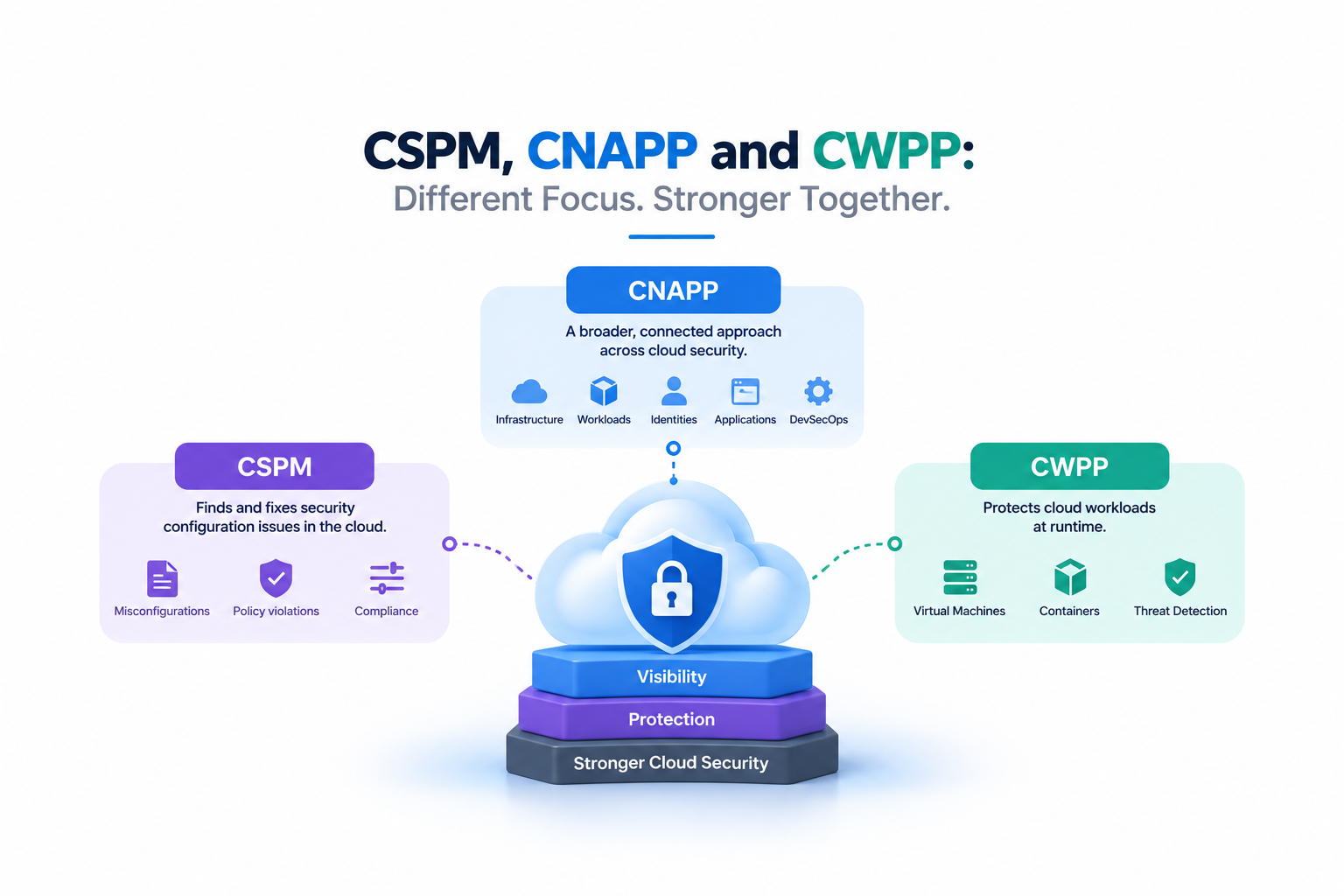
A cloud security team can have several tools monitoring the same environment and still have blind spots.
One platform may identify a misconfigured storage resource. Another may protect a workload from suspicious activity. A third may connect cloud posture, workloads, identities, and application security into a broader view.
That overlap is why CSPM, CNAPP, and CWPP are often compared as if they were competing products. They are related, but they address different security problems. Understanding those differences is more useful than simply comparing feature lists.
What CSPM, CNAPP, and CWPP Actually Mean
The easiest way to distinguish the three is to look at what each one is primarily designed to protect.
Cloud Security Posture Management (CSPM) focuses on the configuration and security posture of cloud environments. It helps identify issues such as overly permissive access, insecure configurations, missing security controls, and policy violations.
Cloud Workload Protection Platform (CWPP) focuses on protecting workloads running in cloud environments. Depending on the platform, those workloads can include virtual machines, containers, or other compute resources. The emphasis is on workload-level protection and detecting or preventing threats affecting those resources.
Cloud-Native Application Protection Platform (CNAPP) takes a broader approach. It brings together multiple cloud security capabilities to provide visibility and protection across infrastructure, workloads, identities, applications, and development processes.
The distinction becomes clearer when looking at the questions each approach helps answer.
CSPM: Finding Problems in Cloud Configuration
Cloud environments can change quickly. New resources are created, permissions are modified, and infrastructure is deployed through automation.
A configuration that was acceptable during deployment may become risky later.
CSPM helps security teams continuously assess cloud configurations against security policies and identify weaknesses that require attention.
For example, a cloud storage resource might be configured in a way that exposes sensitive information. A CSPM capability can identify the configuration problem and provide security teams with a starting point for remediation.
This makes CSPM particularly useful for teams responsible for cloud posture, governance, compliance, and configuration hygiene.
However, posture alone does not explain every security risk. A configuration finding becomes more significant when it is connected to sensitive data, an exposed workload, or a path to a privileged identity.
For a practical example of how seemingly minor configuration issues can create larger problems, see cloud misconfigurations.
CWPP: Protecting Cloud Workloads
CSPM asks whether cloud resources are configured securely. CWPP focuses more directly on the workloads running within those resources.
A workload may be properly configured but still become compromised because of malicious activity, vulnerable software, suspicious processes, or other runtime threats.
CWPP capabilities can help security teams monitor and protect workloads across cloud environments. The exact capabilities vary across platforms, but the underlying objective is consistent: to reduce the risk associated with workloads after deployment.
Consider a production application running on a cloud compute instance. CSPM may identify an insecure configuration surrounding that instance, while CWPP focuses on activity occurring within the workload itself.
The two approaches therefore complement each other rather than necessarily replacing one another.
CNAPP: Connecting Cloud Security Across the Lifecycle
CNAPP addresses a broader challenge: cloud security problems rarely exist in isolation.
A vulnerable application may run on a misconfigured workload. That workload may have access to sensitive resources through an overly permissive identity. The application itself may have entered production via a development pipeline that had security weaknesses.
Looking at each issue separately can make prioritization difficult.
CNAPP brings multiple security capabilities together so teams can understand relationships between cloud infrastructure, workloads, identities, applications, and development processes.
For organizations operating heavily cloud-native environments, CNAPP provides a deeper look at this broader security model.
CSPM vs CNAPP vs CWPP: Which One Should You Choose?
The answer depends on the organization's environment and security objectives.
A team primarily concerned with cloud configuration and compliance may place greater emphasis on CSPM.
A team that needs deeper protection for cloud workloads may need CWPP capabilities.
Organizations managing complex cloud-native application environments may benefit from a CNAPP approach that connects multiple security functions.
The important point is that these categories should not automatically be treated as mutually exclusive.
A security team may use CSPM capabilities as part of a broader CNAPP platform. Similarly, workload protection can be one component of a wider cloud security strategy.
Where Cloud Detection and Response Fits
Prevention and posture management are only part of the problem. Security teams also need to understand what happens when suspicious activity occurs.
That is where cloud detection and response becomes relevant. Detection capabilities help identify potentially malicious behavior, investigate what happened, and support an appropriate response.
This is different from simply identifying a configuration weakness. A resource may be misconfigured for weeks without being exploited, while a compromised workload may require immediate investigation.
Teams looking to understand this operational side can explore cloud detection and response.
Avoiding the “One Platform Solves Everything” Approach
One common mistake is choosing a platform based entirely on the number of capabilities listed in a product comparison.
Security teams should first map their actual requirements.
Ask:
- Which cloud providers and services are in use?
- Are workloads protected consistently across environments?
- How are misconfigurations discovered and prioritized?
- Can security teams understand relationships between identities, workloads, and data?
- How much security activity happens during development and deployment?
- What happens when a potential cloud attack is detected?
- Which findings can be investigated and remediated from the same workflow?
Integration matters as much as feature coverage. A tool that generates thousands of findings without helping analysts determine which ones represent meaningful risk can create another operational problem.
The Practical Difference
CSPM, CWPP, and CNAPP are best understood as different perspectives on cloud security.
CSPM concentrates on posture and configuration. CWPP concentrates on workload protection. CNAPP provides a broader, connected view of cloud-native application security.
The right approach is therefore less about picking a winner and more about understanding which security questions remain unanswered in the current environment.
A mature cloud security program should be able to move from “What is misconfigured?” to “What is exposed?”, “What is affected?”, and ultimately “What requires action first?”
That connection between visibility, protection, detection, and response is what turns a collection of cloud security tools into a more effective security strategy.
About the Author
Sajid Saiyed
Sajid Saiyed leads Cybersecurity Umbrella, driving strategy across cybersecurity services, research, and product innovation. With a focus on building practical, scalable security solutions, he helps organizations strengthen resilience, meet compliance requirements, and confidently navigate an evolving digital landscape.
Is your Cyber Security 2026-Ready?
Stop ransomware and mitigate risks before they happen. Get a free architecture audit from our frontline security analysts.
Schedule a Strategy Call